LOW risk (3.7%), LOW likelihood of benefit
- Decision to stop therapy
- Patient doing well
Tour the Test Report
Prognostic Score
*If ordered at time of diagnosis, test report also provides overall (years 0-10), early (0-5 year), and late (5-10 year) risk of recurrence
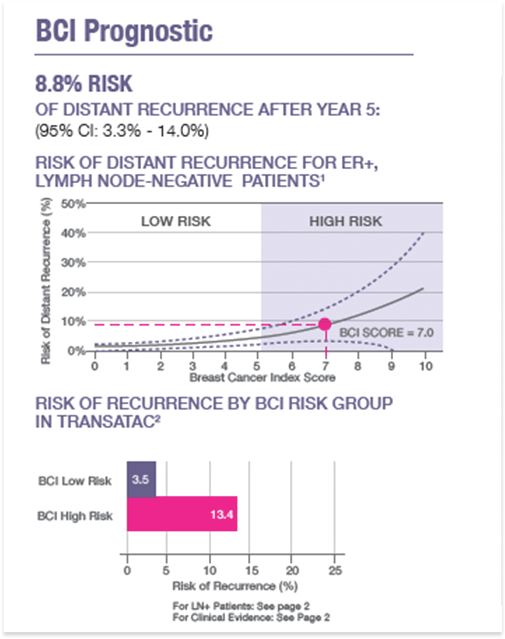 PROGNOSTIC STUDIES
Predictive Score
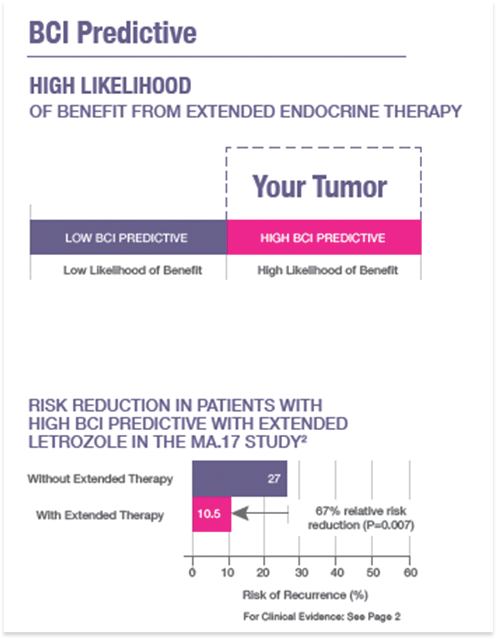 PREDICTIVE STUDIES

Pre-menopausal
Beyond 5 years
Experiencing significant
aromatase inhibitor (AI) side effects
Background
LOW risk (3.7%), LOW likelihood of benefit

Pre-menopausal
On tamoxifen for 5 years
Experiencing bothersome side effects
Background
HIGH risk, HIGH likelihood of benefit
Doctor recommends continuing extended endocrine therapy and routine office visits annually with patients involvement in survivorship program to help manage history of poor compliance

Post-menopausal
Continual AI side effects
Worried about stopping therapy
Background
4.3% LOW risk of recurrence in Years 5 – 10; LOW likelihood of benefit from extended endocrine therapy
Patient anxious about recurrence: BCI gave her peace of mind to stop AI therapy rather than continue one year at a time until NSABP B42 trial completion

Post-menopausal
Year 5
Informed patient (physician and breast radiologist)
Background
4.3% LOW risk of recurrence in Years 5 – 10; LOW likelihood of benefit from extended endocrine therapy
Patient chose not to continue on tamoxifen

Peri-menopausal
Year 7.5
Background
6.6% HIGH risk of recurrence in Years 5 – 10; HIGH likelihood of benefit from extended endocrine therapy
Patient will continue treatment and may go back to tamoxifen

Pre-menopausal
Year 2+
Background
3.1% LOW risk of recurrence in Years 5 – 10; LOW likelihood of benefit from extended endocrine therapy
Patient has decided to stop therapy after 5 years and would like to get pregnant

Post-menopausal
Year 7
Experiencing significant
aromatase inhibitor (AI) side effects
7.4% HIGH risk of recurrence in Years 5 – 10; HIGH likelihood of benefit from extended endocrine therapy
Patient is now post-menopausal and physician has recommended AI treatment for 5 years
BCI provides a quantitative assessment of the likelihood of distant recurrence in patients diagnosed with ER+ node-negative breast cancer, and prediction of likelihood of benefit from extended (>5 year) endocrine therapy in patients who are recurrence-free after an initial 5 years of adjuvant endocrine therapy. Treatment decisions require correlation with all other clinical findings. This test was developed and its performance characteristics determined by bioTheranostics, Inc. lt has not been cleared or approved by the U.S. Food and Drug Administration. This test is used for clinical purposes. lt should not be regarded as investigational or for research. How this information is used to guide patient care is the responsibility of the physician. bioTheranostics is certified under the Clinical Laboratory lmprovement Amendments of 1988 to perform high-complexity clinical laboratory testing.