Understanding the
Unmet Need
About Breast Cancer Index (BCI)
Patient Scenarios Ordering Information Videos News & Press
< Back

Tour the Test Report

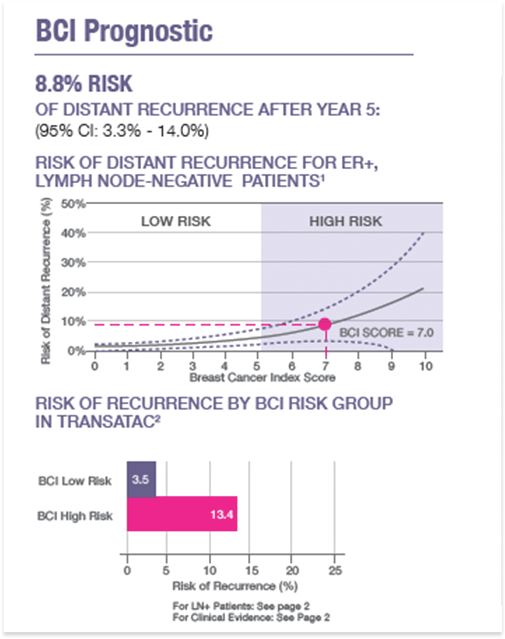
Prognostic Score

  • 0 - 10
  • Individualized risk of late recurrence*

*If ordered at time of diagnosis, test report also provides overall (years 0-10), early (0-5 year), and late (5-10 year) risk of recurrence

Prognostic Study PROGNOSTIC STUDIES

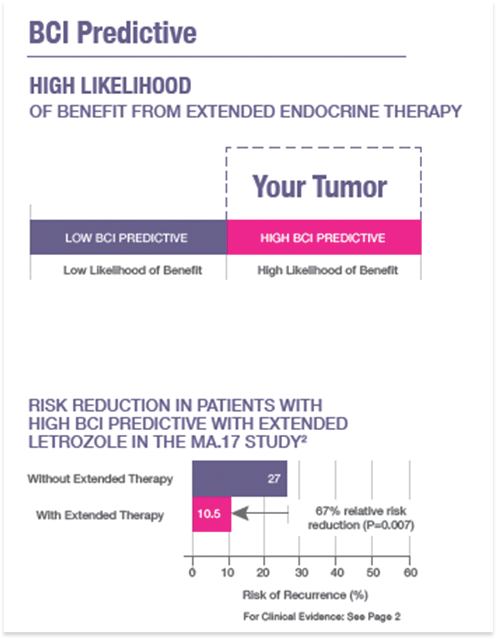
Predictive Score

  • Predictive of likelihood of benefit from extended endocrine therapy
  • HIGH or LOW (binary result)
Predictive Study PREDICTIVE STUDIES

Unnecessary Exposure to Extended Endocrine Therapy

Most patients on extended endocrine therapy are unnecessarily exposed to risks and side effects.

Across 4 major trials, only about

3 – 5% of patients

benefit from extended endocrine therapy.1,2,5-7

Better patient selection is needed to target patients who would benefit from extended endocrine therapy.

Modest patient benefit across trials:*

  • MA.17 trial: 1 in 222
  • ATLAS trial: 1 in 271
  • ABCSG-6a trial: 1 in 236
  • ATTom trial: 1 in 393
View trial summary information
MA.17
Population

Post-menopausal

Treatment

Letrozole (Sy) vs PBO

Trial Size

5187 HR+

Median Follow-up

30m

Absolute Benefit (Risk of Recurrence)
Years 5-9
ABCSG 6a
Population

Post-menopausal

Treatment

Anastrozole (3y)
vs no treatment

Trial Size

856 HR+

Median Follow-up

62.3m

Absolute Benefit (Risk of Recurrence)
Years 5-10
ATLAS
Population

11% Pre- 89% Post-menopausal

Treatment

Tamoxifen (5y)
vs no treatment

Trial Size

6,846 ER+

Median Follow-up

10+ y

Absolute Benefit (Risk of Recurrence)
Years 5-10
aTTom
Population

Pre- and Post-menopausal

Treatment

Tamoxifen (5y)
vs no treatment

Trial Size

6.953 (~90% ER+)

Median Follow-up

8.6y

Absolute Benefit (Risk of Recurrence)
Years 5-10
Extended Therapy
No Extended Therapy

Standard predictive tools:

  • First-generation molecular tests are not validated as clinical tools to help decision-making regarding extended endocrine therapy2-6
  • Demonstrated inability to stratify patients based on risk of late recurrence

Current approaches do not provide the information you need for Years 5-10

Clinical and pathological factors are unable to assess likelihood of benefit from extended endocrine therapy or individualized risk of late recurrence in ER+ patients1

*Absolute benefits in extended endocrine therapy trials: MA.17 trial—4.6% absolute benefit, based on 4-year disease-free survival: 94.4% with letrozole vs 89.8% with placebo. ABCSG-6a trial—4.4% absolute benefit, based on 5-year recurrence rates: 7.8% with 3 years of anastrozole vs 12.2% with extended no treatment. ATLAS trial—3.7% absolute benefit, based on 10-year recurrence rates: 21.4% with extended tamoxifen vs 25.1% with no extended treatment. ATTom trial—2.6% absolute benefit, based on 10-year recurrence rates: 16.7% with extended tamoxifen vs 19.3% with no extended treatment.

Experts agree: establishing better predictive tools is a priority

ASCO 2014 Practice Guidelines

The need was identified for a biomarker to “selectively predict early vs. late recurrence” and “determine whether longer durations of adjuvant endocrine therapy are clinically indicated.”*

Download the BCI Order Form

References

  1. Davies C, et al. Lancet Oncol. 2013;381:805-816.
  2. Goss PE, et al. J Natl Cancer Inst. 2005;97:1262-1271.
  3. Gray RG, et al. J Clin Oncol. 2013;31(suppl):abstract 5.
  4. Burstein HJ, et al. J Clin Oncol. 2010;28:3784-3796.
  5. Burstein HJ, et al. J Clin Oncol. 2014;32:2255 – 69.
  6. Jakesz R, et al. J Natl Cancer Inst. 2007;99:1845-1853.

Breast Cancer Index Indications for Use and Limitations

BCI provides a quantitative assessment of the likelihood of distant recurrence in patients diagnosed with ER+ node-negative breast cancer, and prediction of likelihood of benefit from extended (>5 year) endocrine therapy in patients who are recurrence-free after an initial 5 years of adjuvant endocrine therapy. Treatment decisions require correlation with all other clinical findings. This test was developed and its performance characteristics determined by bioTheranostics, Inc. lt has not been cleared or approved by the U.S. Food and Drug Administration. This test is used for clinical purposes. lt should not be regarded as investigational or for research. How this information is used to guide patient care is the responsibility of the physician. bioTheranostics is certified under the Clinical Laboratory lmprovement Amendments of 1988 to perform high-complexity clinical laboratory testing.