Unmet Need
Tolerability Challenges Unnecessary Exposure to
Extended Endocrine Therapy Side Effects Lead
to Noncompliance
Tour the Test Report
Prognostic Score
- 0 - 10
- Individualized risk of late recurrence*
*If ordered at time of diagnosis, test report also provides overall (years 0-10), early (0-5 year), and late (5-10 year) risk of recurrence
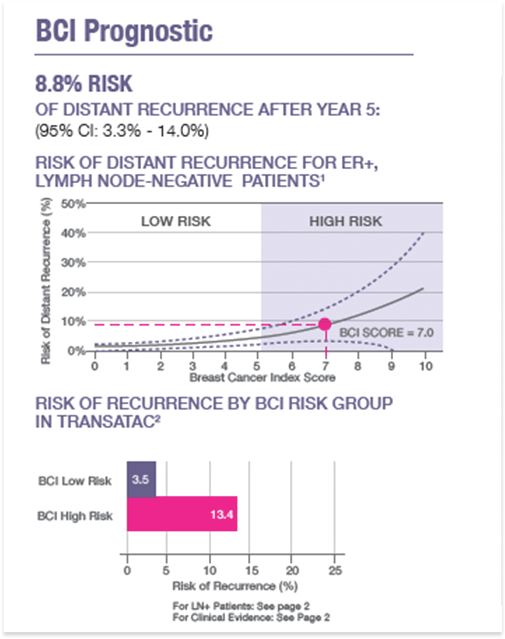 PROGNOSTIC STUDIES
Predictive Score
- Predictive of likelihood of benefit from extended endocrine therapy
- HIGH or LOW (binary result)
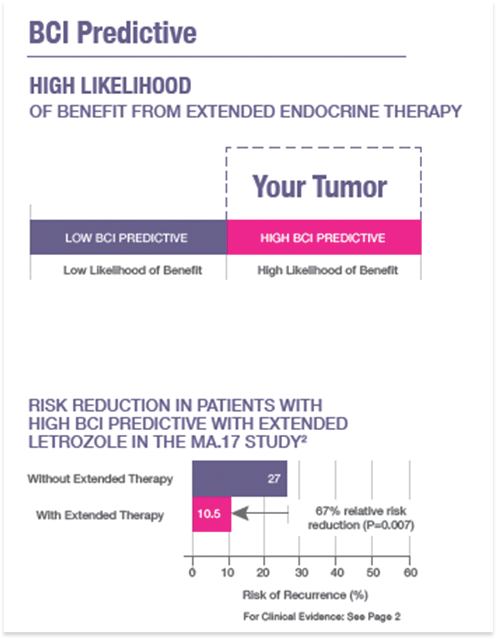 PREDICTIVE STUDIES
The only commercially validated test that predicts the benefit of extended endocrine therapy1
Summary of BCI score validation studies
- 1,340 patients studied across three cohorts
- Two validation studies in randomized prospective trial cohorts
- Consistent stratification in two distinct risk categories
- Large proportion of patients (55% – 64 %) in all three cohorts classified as LOW risk
Distant Recurrence Rate from Years 5–10
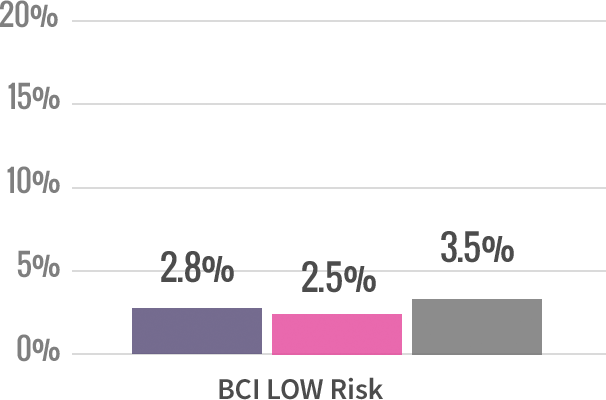
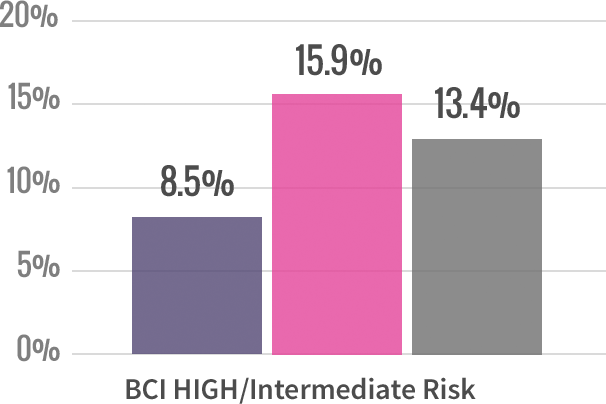
Recurrence risk in a cohort from the TransATAC clinical study1*
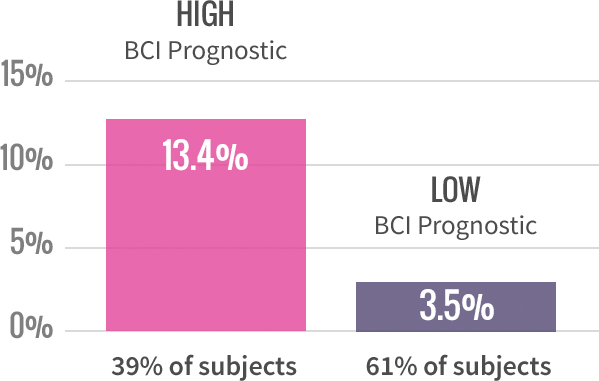
Clinically, BCI could allow many women with early-stage oestrogen-receptor-positive breast cancer to avoid unnecessary extended antihormonal treatment, and could be an important method to aid the management of residual risk after 5 years of adjuvant hormonal treatment.
How low is LOW?
BCI patients identified as BCI LOW risk had 2.5 – 3.5% risk of late recurrence across validation studies
References
- Sgroi DC, et al. Lancet Oncol. 2013;14:1067 – 76.
- Zhang Y, et al. Clin Cancer Res. 2013;19:4196-4205.
Breast Cancer Index Indications for Use and Limitations
BCI provides a quantitative assessment of the likelihood of distant recurrence in patients diagnosed with ER+ node-negative breast cancer, and prediction of likelihood of benefit from extended (>5 year) endocrine therapy in patients who are recurrence-free after an initial 5 years of adjuvant endocrine therapy. Treatment decisions require correlation with all other clinical findings. This test was developed and its performance characteristics determined by bioTheranostics, Inc. lt has not been cleared or approved by the U.S. Food and Drug Administration. This test is used for clinical purposes. lt should not be regarded as investigational or for research. How this information is used to guide patient care is the responsibility of the physician. bioTheranostics is certified under the Clinical Laboratory lmprovement Amendments of 1988 to perform high-complexity clinical laboratory testing.