Understanding the
Unmet Need
About Breast Cancer Index (BCI)
Patient Scenarios Ordering Information Videos News & Press
< Back

Tour the Test Report

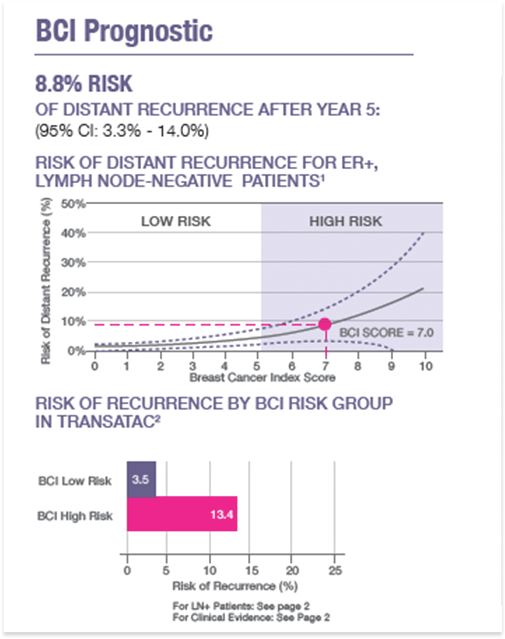
Prognostic Score

  • 0 - 10
  • Individualized risk of late recurrence*

*If ordered at time of diagnosis, test report also provides overall (years 0-10), early (0-5 year), and late (5-10 year) risk of recurrence

Prognostic Study PROGNOSTIC STUDIES

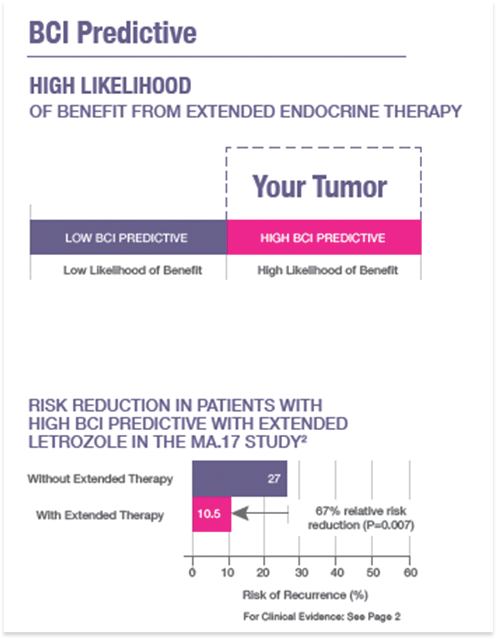
Predictive Score

  • Predictive of likelihood of benefit from extended endocrine therapy
  • HIGH or LOW (binary result)
Predictive Study PREDICTIVE STUDIES

Predictive Studies

The only commercially validated test that predicts the benefit of extended endocrine therapy1

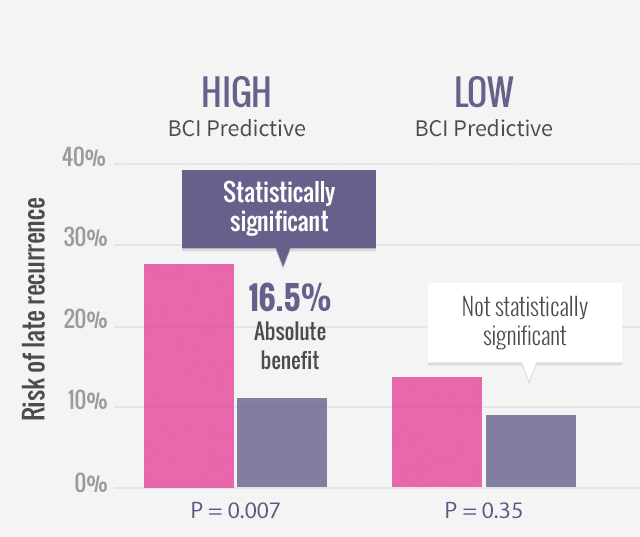
Patients with HIGH BCI predictive score

who received extended endocrine therapy achieved 16.5% absolute benefit versus patients who took placebo (P = 0.007)

  • Associated with relative benefit of 67% reduction in risk of recurrence

Patients with LOW BCI predictive score

received no significant benefit from extended endocrine therapy (P = 0.35)

Risk of Recurrence in MA.17 Trial

Without extended endocrine therapy
With extended endocrine therapy
#
Study Design

Study Design and Statistical Analysis Led by the National Cancer Institute of Canada (NCIC)3

  • Biomarker study designed as a case-control study to enrich for and powered based on number of recurrences examined
  • The study cohort of 249 patients included 83 recurrences, representing >30% of recurrences from the parent trial
  • As a benchmark, this event rate approximates a population-based study of ~2,600 patients from the MA.17 parent trial
  • Cases from patients with recurrences were matched 1:2 with cases from patients that did not recur

Validated in a cohort from the MA.17 clinical study1

Prospective-retrospective study published in the Journal of the National Cancer Institute (July 2013)

The MA.17 parent trial (N = 5,157) demonstrated, for the first time, the clinical benefit of extended endocrine therapy. However, there was a relatively small (4.6%) absolute benefit in the unselected population.1

BCI: proven predictive power

Demonstrated in 3 randomized, controlled trial cohorts to be a statistically significant predictor of response to endocrine therapy1-3

References

  1. Sgroi DC, et al. Lancet Oncol. 2013;14:1067 – 76.
  2. Sgroi DC, et al. J Natl Cancer Inst. 2013;105:1036-1042.
  3. Zhang Y, et al. Clin Cancer Res. 2013;19:4196-4205.

Breast Cancer Index Indications for Use and Limitations

BCI provides a quantitative assessment of the likelihood of distant recurrence in patients diagnosed with ER+ node-negative breast cancer, and prediction of likelihood of benefit from extended (>5 year) endocrine therapy in patients who are recurrence-free after an initial 5 years of adjuvant endocrine therapy. Treatment decisions require correlation with all other clinical findings. This test was developed and its performance characteristics determined by bioTheranostics, Inc. lt has not been cleared or approved by the U.S. Food and Drug Administration. This test is used for clinical purposes. lt should not be regarded as investigational or for research. How this information is used to guide patient care is the responsibility of the physician. bioTheranostics is certified under the Clinical Laboratory lmprovement Amendments of 1988 to perform high-complexity clinical laboratory testing.